
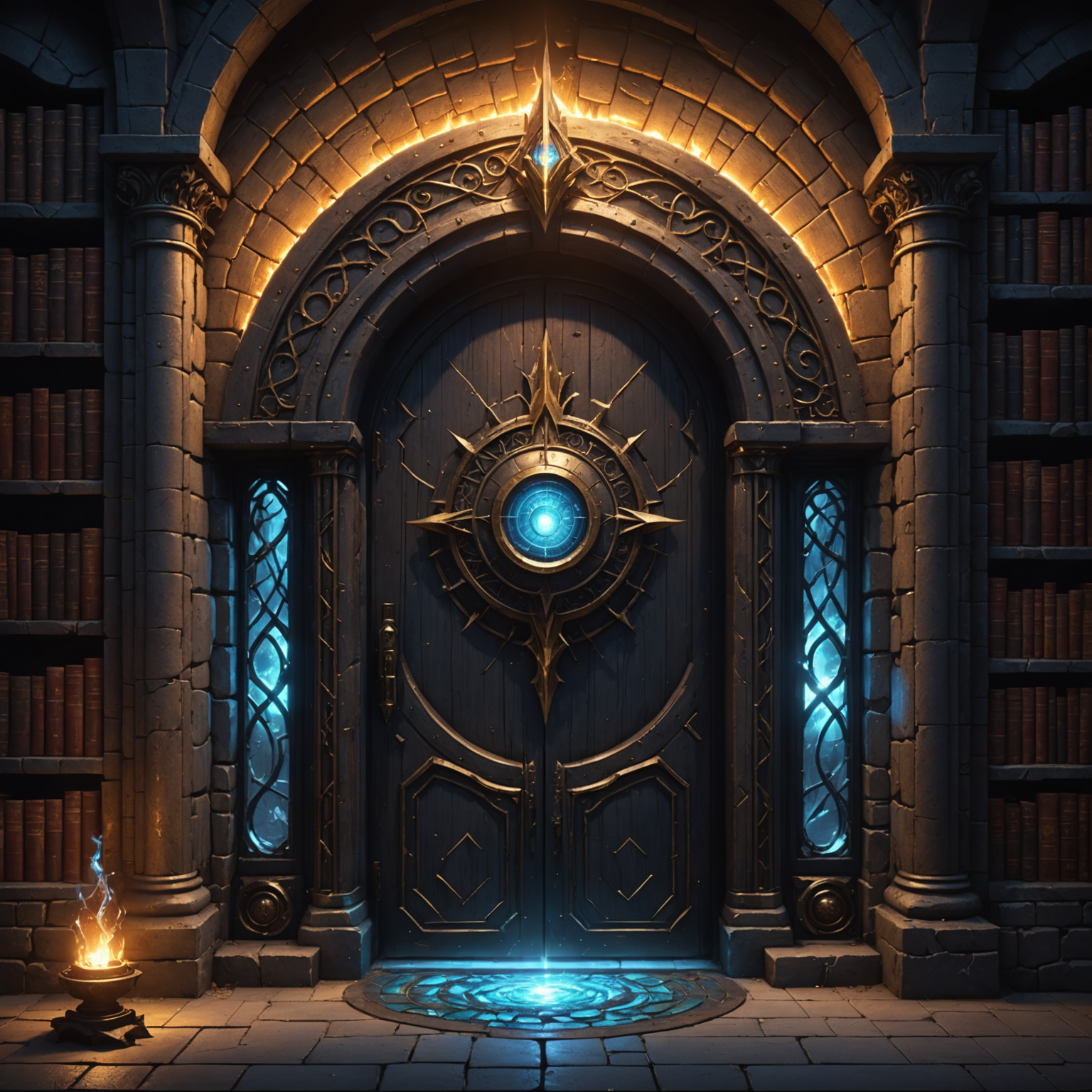
At the center of an ancient arcane library, a solitary sorcerer stands before a gateway formed from living shadow. The portal’s dark energy twists into a deep, luminous vortex, turning an otherwise familiar threshold into an invitation to unknown realms. With its balanced composition and concentrated lighting, the scene places the gateway at the heart of the image while presenting the sorcerer as both its keeper and its potential traveler.
A Gateway Between Worlds
The portal is not depicted as an empty black opening. Its shadows ripple, fold, and curl across the frame like liquid fabric, suggesting movement and contained power. Faint glyphs glow across its surface, giving the gateway the appearance of an object shaped by ancient knowledge rather than ordinary craft. The swirling darkness creates a strong contrast with the surrounding illumination and gives the scene its central tension: the sorcerer appears to command the gateway, but the force beyond it remains difficult to comprehend.
Subtle details reinforce that sense of energy. Tendrils of shadow gather around the structure, while the shifting light catches the edges of the sorcerer’s robes. The garments billow gently, implying that the portal affects the air around it. Together, these details make the gateway feel active and unstable without losing the stillness of the suspended moment.
The Library as a Setting
The surrounding library expands the scene beyond a simple portrait of magic. Towering shelves disappear into the darkness, packed with cryptic volumes whose spines carry traces of ancient runes. Ethereal flames provide a flickering source of ambient light, illuminating selected books and artifacts while leaving other corners hidden.
This layered lighting helps define the library’s role. It is not merely a decorative backdrop but a visual record of the knowledge the sorcerer protects or seeks. Warm, faint illumination from the shelves contrasts with the colder darkness of the portal, creating a clear division between stored wisdom and the unknown space beyond the gateway. Ancient stone beneath the figure adds a grounded, tactile quality to the fantastical environment.
Light, Texture, and Atmosphere
Dramatic lighting draws attention to the scene’s most important features: the sorcerer, the glyph-marked portal, and the shadow energy connecting them. It also reveals the textures that give the artwork its sense of depth, from the folds of the robes to the rough stone floor and the reflective surfaces of nearby objects.
The result is an immersive fantasy composition built around contrast. Bright runes and spectral flames emerge from heavy darkness, while the figure’s controlled stance provides a visual anchor amid the movement of the portal. Small details, including the glow reflected in the sorcerer’s eyes and the faint markings surrounding the gateway, reward close attention.
A Scene Built for Storytelling
The image leaves the portal’s destination unresolved, allowing viewers to imagine what lies beyond it and why the sorcerer has opened the way. Is the gateway a passage, a seal, or a test of magical discipline? The artwork does not need to answer those questions directly. Its atmosphere of forbidden knowledge, controlled power, and unanswered possibility creates the narrative.
With its cinematic scale, detailed environment, and safe-for-work presentation, this fantasy scene turns a library into a threshold between realities. Shadow and sorcery dominate the composition, but the enduring focus is curiosity: the desire to step closer, read the hidden runes, and discover where the enigmatic gateway leads.