
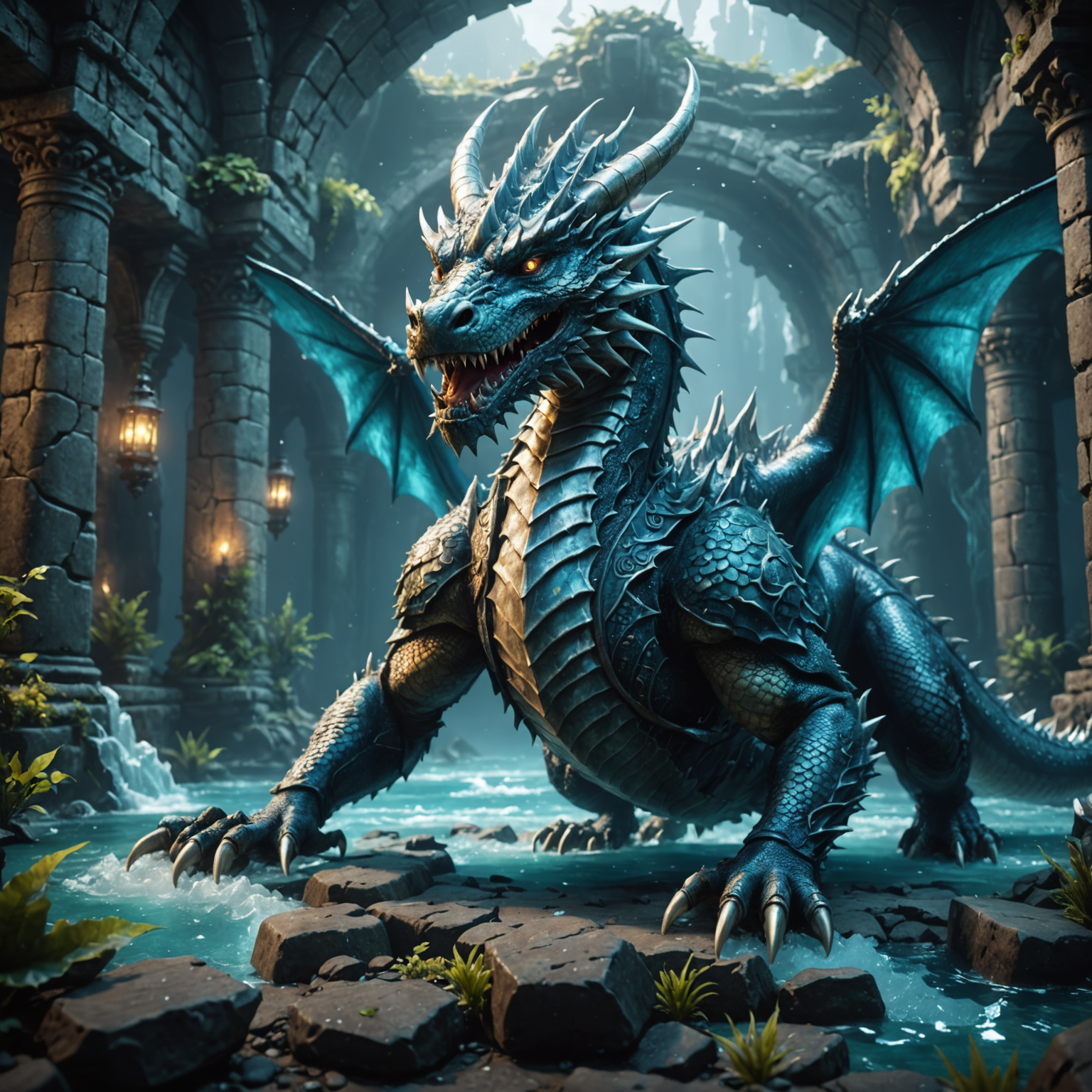
Deep beneath the surface lies a drowned city where broken temples, silent pillars, and drifting strands of aquatic growth preserve the memory of a vanished age. At the heart of this submerged landscape stands the Frostbound Champion, a powerful dragon shaped by winter magic and the cold, mysterious currents of its domain.
A Dragon of Ice Beneath the Waves
Unlike the traditional image of a fire-breathing dragon, this champion embodies cold, stillness, and crystalline force. Frost clings to its scales in bright, uneven layers, while jagged ice forms the edges of its horns and wings. Its frozen breath disappears into the surrounding water like a pale cloud, creating the impression that the creature is changing the temperature of the ruins around it.
The dragon’s design works best when its strength is balanced with a sense of ancient purpose. Its alert expression and grounded stance suggest a vigilant guardian rather than a beast attacking without reason. It appears to be watching over the secrets, relics, and lost treasures concealed within the sunken city.
Building the Underwater Setting
The ruins provide more than a decorative background. Their fractured architecture gives the scene a history and a sense of scale. Collapsed columns can frame the dragon’s body, while moss-covered walls and damaged temple structures guide the eye toward the central figure. Details such as suspended particles, submerged plants, and softened edges help establish the heavy, quiet atmosphere of the deep.
A restrained blue palette allows the frost to stand out. Muted aquatic tones can fill the distant ruins, while silver-white highlights define the dragon’s scales, claws, horns, and wings. This contrast makes the ice appear luminous without separating the creature from its environment. The result is a scene in which the dragon and the underwater city feel connected by the same supernatural cold.
Light, Focus, and Visual Depth
Cinematic lighting can give the composition its strongest sense of drama. Narrow beams filtering down from above may illuminate portions of the ruins and catch the frost along the dragon’s back. Elsewhere, deep shadows can conceal broken passageways and create uncertainty about what lies beyond the visible scene.
Depth of field is especially useful in this setting. Keeping the dragon’s face, scales, and ice-crystal details sharply defined draws attention to its character and physical presence. Background vegetation and distant architecture can gradually soften, recreating the limited clarity of an underwater environment while making the champion feel larger and more immediate.
Using the Concept in Fantasy Art
The Frostbound Champion offers artists a strong foundation for visual storytelling because the creature, setting, and elemental theme all support one another. A finished image might emphasize:
- the contrast between delicate frost and immense dragon anatomy;
- the tension between a ruined civilization and its enduring guardian;
- the movement of light through water, particles, and drifting plant life;
- the mystery of what remains hidden inside the submerged temples.
Whether developed as a character-design study, a game-world centerpiece, or a standalone fantasy illustration, the scene presents a memorable alternative to familiar dragon imagery. It combines the grandeur of an ancient legend with the quiet isolation of the deep, creating a frozen underwater saga in which every shard of ice and fragment of stone hints at a larger forgotten history.