
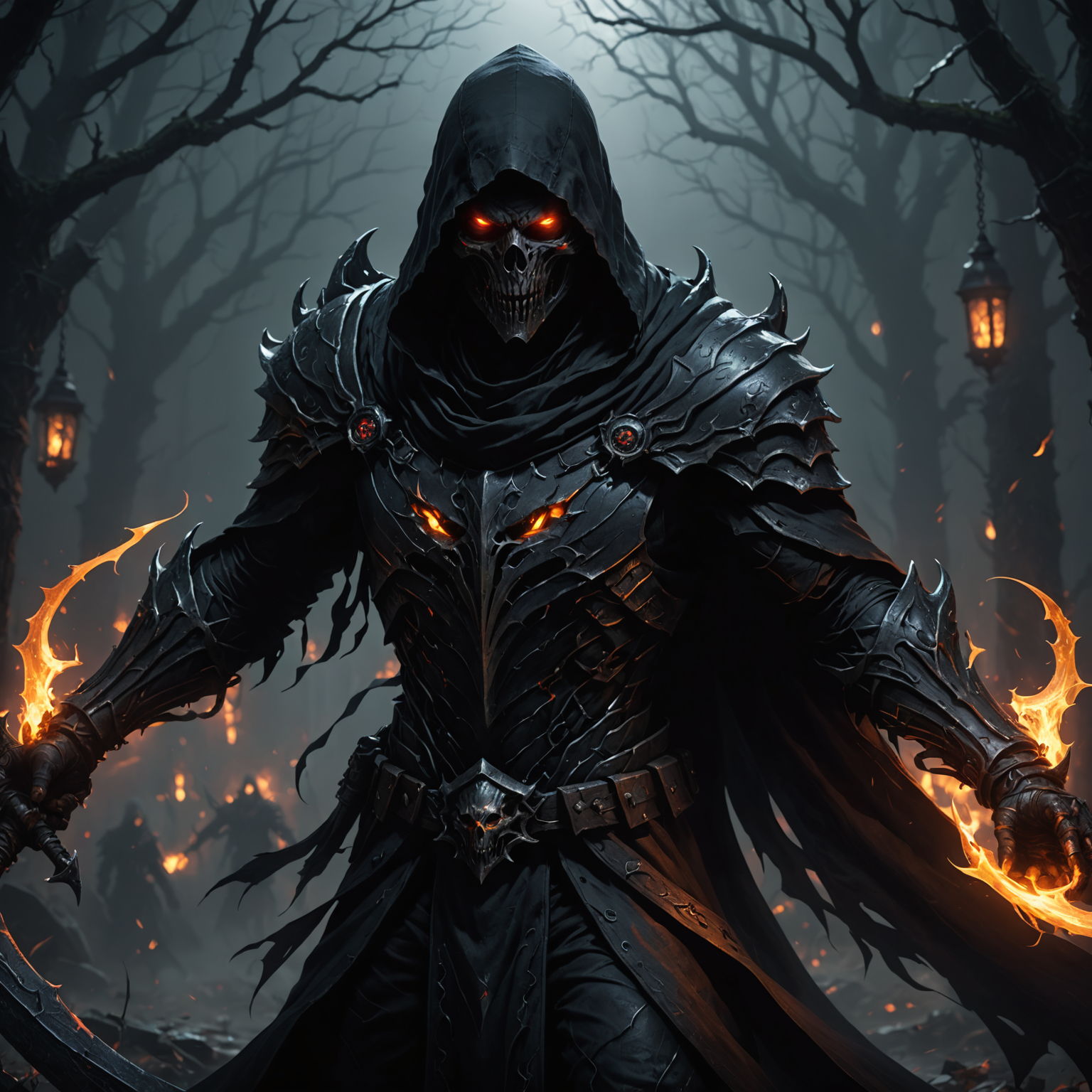
The Shadow Realm Reaper is a dark fantasy figure defined by concealment, atmosphere, and unanswered questions. Rather than presenting the creature in full detail, the artwork allows it to emerge gradually from a field of darkness. Swirling shadow forms obscure parts of the body, while faint luminous accents draw attention to the face, weapon, and shifting outline.
A Figure Shaped by Shadow
The reaper’s form appears unstable, as though it belongs to a place where ordinary physical rules no longer apply. Flowing edges and partially hidden features make the entity feel less like a solid warrior and more like a presence moving through another plane of existence. Its silhouette remains readable, but important details are left open to interpretation.
This restraint is central to the image’s impact. Showing every feature would make the character easier to understand, but hiding much of the figure gives it a stronger sense of mystery. The viewer is encouraged to decide whether the shape contains armor, robes, smoke, or something that cannot be clearly defined.
The Meaning of a Shadow Realm Reaper
In fantasy storytelling, a reaper-like entity can represent the boundary between opposing states: life and death, the visible world and the unseen, or order and chaos. The character does not need a detailed history to suggest a larger role. Its posture, weapon, and isolated surroundings can imply that it watches over a passage or carries out a duty connected to a hidden realm.
Possible interpretations include:
- A guardian standing at the entrance to an unknown dimension
- A guide leading spirits through a dangerous transition
- An agent of judgment operating beyond ordinary law
- A wandering force that maintains balance between conflicting worlds
- A symbol of fear, transformation, and the unknown
Contrast, Light, and Visual Tension
The composition relies on a narrow range of tones. Deep blacks establish the surrounding void, while restrained highlights reveal just enough of the entity to hold the viewer’s attention. Small glowing elements may suggest eyes, magical energy, or reflections along a weapon, creating focal points without weakening the overall darkness.
This contrast also creates visual tension. The figure feels close enough to confront, yet distant enough to remain unreachable. Shadow appears to move around the body, making the reaper seem as if it is forming and dissolving at the same time. Soft motion effects reinforce that impression and give the scene an otherworldly rhythm.
An Environment Beyond the Familiar
The sparse setting supports the character rather than competing with it. A void-like background or abstract landscape removes ordinary references such as buildings, roads, or recognizable horizons. Without those details, the viewer cannot easily judge scale or location. The reaper may be standing in an empty dimension, crossing an unseen boundary, or existing in a space shaped entirely by shadow.
Why the Image Invites Interpretation
The Shadow Realm Reaper works as fantasy art because it suggests a story without fixing one final explanation. Its hidden features, shifting outline, and uncertain purpose leave room for imagination. It can be read as a monster, protector, executioner, guide, or living symbol of transition. That ambiguity gives the artwork its lasting atmosphere: the most important part of the entity is not what the darkness reveals, but what it leaves concealed.